
Kingdom Worker Ministries Blog
Are you Psalm 91 equipped? Have you made your declaration today? The Bible says that when you decree or declare a thing it shall be established, or it shall come to pass (Job 22:28). When you decree or declare a thing, expect to see it, expect it to come to pass. So, let us decree this thing, let us declare Psalm 91 in the mighty name of Jesus and watch it come to pass. Hallelujah, Glory to God.
“For the wages of sin is death …” (Romans 6:23).
Most believers are very familiar with this passage of scripture, but few have given any deep thought to what this passage is actually telling us. Just as you expect to receive “compensation or a wage” for working in any job, be it full-time or part-time, you should expect to receive “compensation or a wage” for working or living in sin, be it full-time or part-time. While the “compensation or wage” for employment is usually some type of monetary benefit, the compensation or wage for sin is “death.” Therefore, this passage is really saying to us that “the wages, the salary, the pay, the income, the take-home pay” of sin, no matter that amount of sin, is “death.” Imagine that, working in sin, playing in sin, living in sin, or just existing in sin pays a benefit, which according to scripture is death.
Now, there are some so-called believers who still have pieces of their old sinful nature still living within them. While they have been able to put to death many aspects of their old sinful natures, many choose to keep souvenirs, keepsakes, and mementos, in an attempt to cling to particular portions of their old sinful life. And while there are varying amounts being kept, these tokens only serve as reminders of a life gone by, a life that was completely ruled by a sinful nature. The problem with keeping these souvenirs, these tokens alive, it gives opportunity for temptation to do its thing.
If it is true that God cares, then why doesn’t he do something to show us he cares? If it is true that God cares, then why doesn’t he do something about all the wrong that is in the world? If it is true that God cares, then why does he sit silently by and allow bad things to happen? Is this what a caring God does? The truth of the matter is that God really does care and has done all that he can do to take care of the problems that so many face. When God first created man, he created man to have dominion over all of his creation (Genesis 1:26-28).
“What is man, that thou art mindful of him? and the son of man, that thou visitest (pay attention to or care for) him? For thou hast made him a little lower than the angels, and hast crowned him with glory and honor. Thou madest him to have dominion over the works of thy hands; thou hast put all things under his feet: all sheep and oxen, yea, and the beasts of the field; the fowl of the air, and the fish of the sea, and whatsoever passeth through the paths of the seas” (Psalm 8:4-8).
Life is good. As a child of God, life is truly good. We know that some will disagree, because they see the daily struggles of those who succumb to poverty, sickness, and death, the primary battle involves depression, fear, discouragement, low self-esteem, worry, anxiety, confusion, doubt, and many other things and say “With all that we see in the world, how can anyone say life is good?” It all depends on the lens through which you see the world.
“These things I have spoken unto you, that in me ye might have peace. In the world ye shall have tribulation: but be of good cheer; I have overcome the world” (John 16:33).
Jesus tells us that we will have many trials, many tribulations, many afflictions, and many sorrows but we should cheer up and keep our courage up. While trials, tribulations, afflictions, and sorrows do not sound like there is much for anyone to be cheerful about, Jesus still tells us that when these things come, and they will come, we need “to be of good cheer.” Jesus says, “in him we can have peace,” if we “be of good cheer,” because he has overcome all of these things and won victory over all the world.

The scripture tells us that Jesus said, “I am come that they might have life, and that they might have it more abundantly” (John 10:10). When Jesus died on the cross, he gave man the privilege to become a child of God, so that all could share in the blessing of Abraham and receive the promise of the Spirit through faith.
“But to all who believed him and accepted him, he gave the right to become children of God. They are reborn—not with a physical birth resulting from human passion or plan, but a birth that comes from God” (John 1:12-13NLT). “Through Christ Jesus, God has blessed the Gentiles with the same blessing he promised to Abraham, so that we who are believers might receive the promised Holy Spirit through faith” (Galatians 3:14 NLT).
As a child of God, man now has the right to the inheritance of the new covenant, a better covenant, built with better promises (Hebrews 8:6-13), the right to a divine inheritance to the best in life, deserving all the Father has to offer (Romans 8:14-17), which includes the right to good health, wealth, and total life prosperity.
“He is despised and rejected of (forsaken by) men; a man of sorrows (pains), and acquainted with grief (sickness): and we hid as it were our faces from him; he was despised, and we esteemed him not. Surely he hath borne our griefs (sicknesses), and carried our sorrows (pains): yet we did esteem (reckon) him stricken, smitten of (struck down by) God, and afflicted. But he was wounded (pierced through) for our transgressions, he was bruised (cruised) for our iniquities: the chastisement of our peace was upon him; and with his stripes (blows that cut in) we are healed” (Isaiah 53:3-5). “Who his own self bare our sins in his own body on the tree, that we, being dead to sins, should live unto righteousness: by whose stripes (wounds) ye were healed” (I Peter 2:24).
Most people do not believe that we choose what happens to us. Regardless of how things appear in the world, the truth of the matter is that the words we speak play an important role in what happens in our life. The Bible tells us that “death and life are in the power of the tongue” (Proverbs 18:21), which suggests that with one’s mouth an individual can speak death into his or her life or the same individual can speak life into his or her life. We know that the words that we speak are like seeds that are planted in the ground and it is from those seeds, we reap the blessings or the cursings from that which we have sown (Galatians 6:7-8). This is why the words that we speak are so important; they really do control the things that happen to us. It is like “the entire system of blessings and cursings” hinges upon the very words we speak.
“We can make a large horse turn around and go wherever we want by means of a small bit in his mouth. And a tiny rudder makes a huge ship turn wherever the pilot wants it to go, even though the winds are strong. So also the tongue is a small thing, but what enormous damage it can do. A great forest can be set on fire by one tiny spark. And the tongue is a flame of fire. It is full of wickedness, and poisons every part of the body. And the tongue is set on fire by hell itself and can turn our whole lives into a blazing flame of destruction and disaster. Men have trained, or can train, every kind of animal or bird that lives and every kind of reptile and fish, but no human being can tame the tongue. It is always ready to pour out its deadly poison” (James 3:3-8 TLB).

Have you ever felt like giving up? Well, do not feel like this is a feeling that is exclusively yours. It is not. We have all felt like giving up, giving in, and/or giving way. But know that this “feeling of giving up” is not of God; it is of the devil.
“Finally, my brethren, be strong in the Lord, and in the power of his might. Put on the whole armor of God, that ye may be able to stand against the wiles of the devil” (Ephesians 6:10-11). “Wherefore take unto you the whole armor of God, that ye may be able to withstand in the evil day, and having done all, to stand” (Ephesians 6:13). Above all, taking the shield of faith, wherewith ye shall be able to quench all the fiery darts of the wicked (Ephesians 6:16).
God does not want us to give up. God wants us to be strong in him and in the strength of his mighty power. God wants us to put on the whole armor that he has provided for us so that we will be able to stand firm against all of the wiles or strategies of the devil. God wants us to put on his full armor so that we, having done all to stand, will be able to stand in our times of evil. Among the articles of armor listed, God says above all, “take or hold up the shield of faith” so that we will be able “to quench or stop the fiery darts of the wicked.”

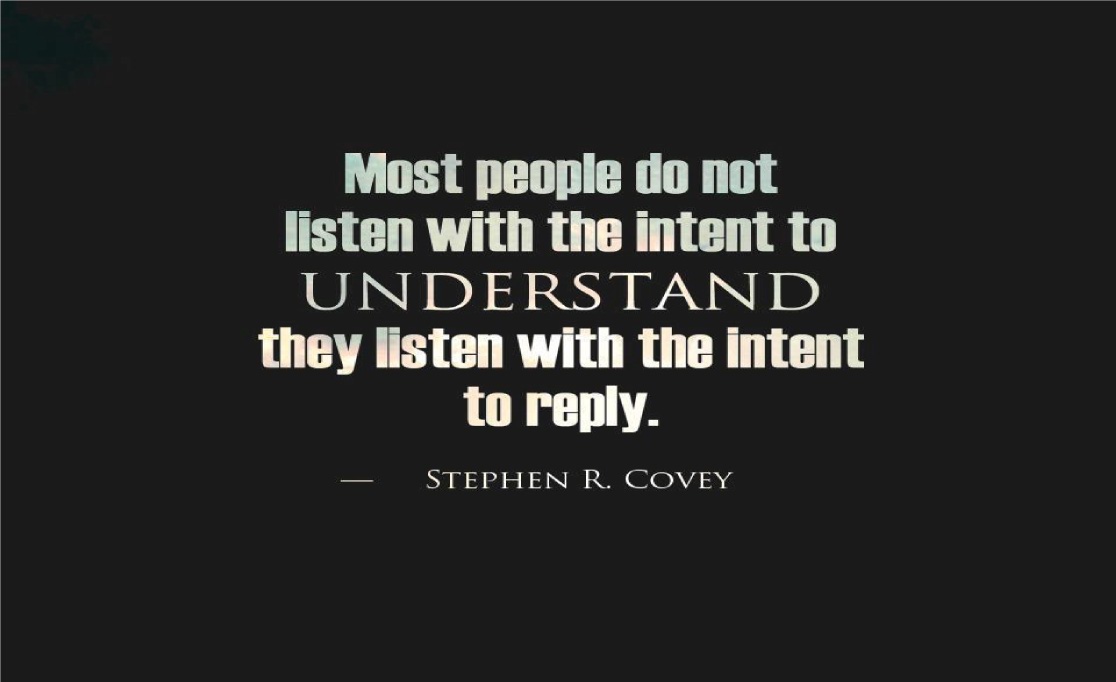
It is sad but true, “Most people do not listen with the intent to understand, they listen with the intent to reply” (Stephen R. Covey). The biggest problem with our ability to communicate with each other is the fact that most of us do not listen to understand what someone else is trying to say, we listen for the sole purpose of having a response.
“My dear brothers and sisters, take note of this: Everyone should be quick to listen, slow to speak and slow to become angry” (James 1:19 NIV).
Scripture tells us that we all should listen more and talk less. The reason we should listen more and talk less is that when we are talking we are not listening. By not listening, we tend to miss many revelations, those important little things that could take our understanding to another level. You see all things are important when it comes to the things of God, no matter how trivial they may appear to be. There is so much information to tell, so much information to share, and still so much more information to find. So much so that unless you get all the information at one time, a lot of it gets lost long before we can get to the next session. But we do not listen to hear, we listen with the intent to reply. Have you seen the evidence?
Do you know that you are “an ambassador?” Most people do not realize that they themselves are in fact “ambassadors.”
According to the Merriam- Webster Dictionary, “an ambassador” is
“a diplomatic agent of the highest rank accredited to a foreign government or sovereign as the resident representative of his or her own government or sovereign or appointed for a special and often temporary diplomatic assignment.”
Basically, “an ambassador” is “an authorized representative or messenger.”
“Don’t you realize that you can choose your own master? You can choose sin (with death) or else obedience (with acquittal). The one to whom you offer yourself—he will take you and be your master, and you will be his slave” (Romans 6:16 TLB).

A registered 501(c)(3) nonprofit organization
EIN 84-2866702.
Office Hours:
Meetings available upon request.
Get in Touch
Phone:
(540) 382-9132
Mailing Address:
Kingdom Worker Ministries
P. O. Box 33
Christiansburg, VA 24068-0033